


Classic liquid-nitrogen immersion remains hard to beat on simplicity. ITS now has to prove that lower thermal stress can justify a more complex storage system.
Its weakness appears during the final part of cooldown. Vitrified tissue becomes mechanically glass-like, then contracts further as it descends toward liquid-nitrogen temperature.
Intermediate Temperature Storage, or ITS, asks whether a patient can remain safely glassy at a warmer temperature while accumulating less thermomechanical stress.
The idea is promising. The engineering is more demanding than the phrase "store around -140°C" makes it sound.
That engineering has now reached human scale. In August 2026, the first human-sized ITS dewar arrived at the EBF facility for testing by Tomorrow.bio.

The problem begins at the glass transition
A cryoprotectant solution does not become a glass at one perfectly sharp temperature. Its viscosity increases across a transition region as molecular motion becomes extremely slow.
The quoted glass-transition temperature, or Tg, is an operational reference obtained under specified measurement conditions.
Above this region, stress can relax because the material can still flow on a relevant timescale. Below it, the vitrified system increasingly responds like a brittle solid.
Cooling then causes contraction. Different tissues, cryoprotectant concentrations and support materials can contract by different amounts.
A large patient also develops spatial temperature gradients. The exterior responds to its surroundings before the core reaches the same temperature.
Those differences create strain. If tensile stress exceeds the local strength of the vitrified material, a fracture can form.
Peer-reviewed thermomechanical modelling shows that geometry, cooling history and temperature gradients all influence stress in large vitrified specimens.
Why slow cooling helps but cannot settle everything
Slow, uniform cooling reduces temperature differences across the patient. An annealing hold near the transition region gives some stress time to relax before deeper cooling.
This is why Tomorrow.bio uses a controlled trajectory through the final stages of whole-body cooldown.
Cooling rate is not the only variable. Constraints between tissues, container surfaces and support structures can still generate stress as materials contract differently.
Human-scale geometry matters too. A protocol that avoids fractures in a small solution sample cannot be assumed to do the same in a whole body.
Recent experimental work confirms that fracture behaviour also depends strongly on the cryoprotectant's Tg and material properties, not merely the final temperature.
ITS therefore reduces one major driver by shortening the descent below Tg. It does not prove that every source of fracture has disappeared.
The ITS temperature is a band, not a slogan
"Around -140°C" is a useful orientation point. It is not a universal set point for every patient and every cryoprotectant formulation.
The upper boundary must remain sufficiently below the relevant transition region that all protected tissue stays glassy despite gradients, sensor uncertainty and control variation.
The lower boundary reflects the additional contraction and stress that ITS is intended to avoid.
A defensible operating band must account for cryoprotectant concentration. Poorly perfused regions may have a different thermal state from well-protected regions.
It must also account for measurement location. A sensor reports its own temperature, not the temperature of every point inside a human body.
The design problem is therefore spatial: keep the warmest relevant point cold enough and the coldest relevant point from descending unnecessarily.
Why ordinary nitrogen vapour is not enough
The space above liquid nitrogen is cold, but it is not naturally isothermal.
Gas near the liquid surface is colder than gas near the lid. Heat enters through the neck and walls, creating vertical and radial gradients.
Simply suspending a patient somewhere above the liquid would not create a defined whole-body storage temperature.
An ITS system needs an internal thermal architecture that smooths those gradients and controls heat flow around the patient.
Published ITS concepts use combinations of conductive liners, insulated patient enclosures, nitrogen vapour and controlled electrical heating.
The heater sounds counterintuitive. Its purpose is not to create cold, but to regulate a nitrogen-cooled enclosure at a stable temperature warmer than the surrounding cryogenic sink.
One control problem, several possible architectures
An ITS vessel can use liquid nitrogen as its cold reservoir while controlling the patient's temperature in the vapour space above it.
Another design can regulate effective cooling capacity by controlling how strongly the storage chamber couples to that reservoir.
Fans, conductive structures or controlled gas circulation can improve uniformity. Each component changes the vessel's heat flows and failure modes.
The exact architecture matters more than the ITS label. Two vessels at the same nominal set point can have very different gradients, reserves and fault behaviour.
Brian Wowk's technical overview of ITS systems explains early conductive-liner and vapour-control designs.
Those prototypes demonstrate physical approaches. Their capacities and hold times should not be generalized to newer whole-body systems.
The control loop must see the whole patient
A controller compares measured temperature with a target, then adjusts heaters, nitrogen flow or another actuator.
One sensor is insufficient for a human-scale object. It could report a stable value while another region drifts outside the intended band.
Validation should therefore map temperatures at multiple heights, radial positions and representative internal locations during steady operation and transitions.
Sensor placement must distinguish air or vapour temperature from patient temperature. The two can diverge during cooling, disturbances and recovery.
Control stability also matters. A system that repeatedly overshoots and corrects can impose thermal cycling even if its long-term average looks acceptable.
The useful result is not a clean set-point display. It is a demonstrated envelope across the stored volume under realistic loads.
ITS changes the failure trajectory
In a classic immersion dewar, sufficient liquid fixes the patient near nitrogen's boiling temperature without active thermal control.
ITS adds sensors, control logic, actuators and electrical systems. Those components improve temperature control during normal operation and create more ways normal operation can fail.
A safe design should fail gradually and visibly. Alarms must trigger before the patient approaches either boundary of the validated temperature band.
A loss of heating or circulation may drive the chamber colder rather than warmer in some nitrogen-backed designs.
That direction can preserve the glassy state while increasing fracture risk. It may be preferable to warming above the safe upper limit, but it is not harmless.
Other failures can reduce nitrogen inventory or isolate the patient from the cold source. The fault response depends on the specific vessel.
This is why "passive backup" must be tested as a sequence, not asserted from the presence of liquid nitrogen somewhere in the system.
What a serious validation programme measures
Commissioning begins with an instrumented thermal load that represents the patient's size, heat capacity and geometry.
Testing should establish steady-state uniformity, cooldown behaviour, nitrogen consumption, electrical demand and temperature cycling.
It should deliberately simulate sensor faults, controller faults, stuck valves, power loss, depleted nitrogen, communication loss and delayed human response.
Recovery matters as much as failure. The system should return to its validated band without creating dangerous gradients or overshoot.
Calibration drift and sensor disagreement need defined detection rules. Redundant sensors add little if software silently accepts whichever reading is most convenient.
Hold time should be reported against explicit boundaries: starting inventory, ambient condition, failure mode and the temperature threshold used to define failure.
A vessel is ready for patient care only after its normal performance and credible abnormal states are characterized.
ITS may improve future rewarming options
Fractures do not necessarily erase the microscopic structure on each side of a crack. They do make straightforward rewarming and reperfusion substantially harder.
Reducing fracture burden could therefore reduce the amount of structural repair required before biological function could be restored.
Warmer starting temperatures also shorten part of a future rewarming trajectory. They do not solve ice formation, cryoprotectant toxicity or non-uniform heating.
Current research on vitrified organs still treats cracking and crystallization as separate hazards that must both be controlled.
ITS improves one term in a much larger reversal problem. It is not suspended animation and does not make present-day revival possible.
Tomorrow.bio's current implementation status
Tomorrow.bio's public research roadmap describes implementation of a whole-body ITS solution as an active storage project.
On Thursday, 13 August 2026, Tomorrow.bio received its first human-sized ITS dewar at the EBF facility in Rafz.
The human-sized system was designed by 21st Century Medicine.
This makes Tomorrow.bio the first cryopreservation organization in the world to possess a human-sized ITS dewar.
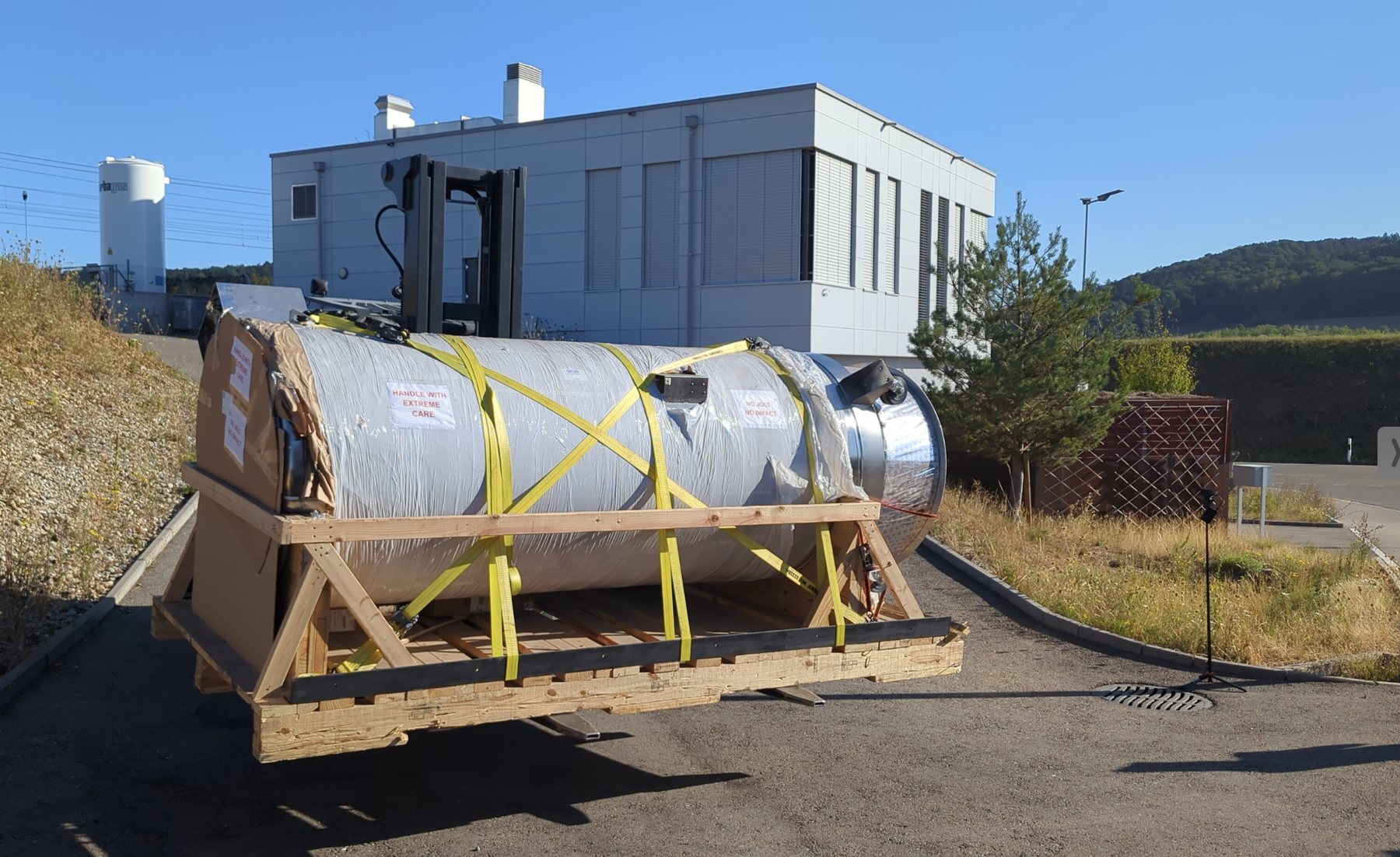
The dewar is not yet in routine patient service. It has entered a test phase expected to last several months.
The programme will measure liquid-nitrogen consumption, temperature stability, spatial uniformity, control behaviour and performance over extended operation.
The team will also identify failure points and test how the system behaves when sensors, controls, power or nitrogen delivery do not operate normally.
Those results will determine operating limits, monitoring requirements, maintenance procedures and the fault-response plan.
Arrival proves that human-sized ITS hardware now exists at EBF. It does not yet prove validated routine patient storage.
The responsible order remains instrumented testing, fault testing, documented acceptance and only then operational use.
How to compare ITS with classic immersion
The comparison is not "advanced" versus "obsolete". Each architecture protects against a different risk profile.
Classic immersion offers exceptional passive stability and simple thermodynamics. Its deeper temperature can add contraction and thermomechanical stress.
ITS reduces that temperature descent and may reduce fracturing. It requires tighter control, more components and a more detailed validation case.
The right evaluation compares total risk: fracture burden, temperature margin, failure response, hold time, maintenance, transfer procedures and institutional capacity.
The surrounding storage facility must be able to operate whichever vessel is chosen for decades, not merely demonstrate it once.
The honest conclusion
ITS addresses a real weakness in whole-body cryopreservation: the mechanical consequences of cooling a large vitrified system far below its glass transition.
Its benefit is physically plausible and supported by thermomechanical research. The exact benefit for a human patient remains dependent on implementation and measurement.
The technology earns confidence through temperature maps, fault tests, long-duration operation and transparent commissioning data.
TL;DR: Intermediate-temperature storage aims to reduce deep-cooling stress by holding patients above -196°C. It may reduce cracking but requires active control, more equipment and extensive testing.
Further reading