

The Best Whole Genome Sequencing Provider
Approaches to personal genomics
Your genome is the entirety of your genetic material, involving both coding (genes) and non-coding regions. The human genome consists of 3 billion base pairs of our core genetic material, the DNA. Genomics is the study of structure, function, evolution, and mapping of genomes. Population genomics allows for a deeper understanding of DNA variants statistically associated with higher likelihood of developing a particular condition, without guaranteeing that it will occur. These sequences are called genetic risk factors, and rarely act alone. They often interact with environmental and lifestyle factors to determine overall risk.
With the rapid development of sequencing technologies and their capacity to detect inherited diseases, it is very tempting to send your own sample for genomic sequencing. There are two approaches to personalized genomics: 1) genotyping and 2) whole genome sequencing.
Genotyping determines the state of a targeted set of genetic sites within the genome (~600,000 sites in your genetic sequence). Genetic variations known as single nucleotide polymorphisms (SNPs) are investigated and compared. Commercially available genotyping can be used for ancestry breakdowns, traits and some health indicators. Another example of genotyping are gene panels, which focus on sequencing a pre-determined set of genes and are often requested by clinicians.
Whole genome sequencing is the process of determining the entire DNA sequence of an individual’s genome at once. WGS captures most genomic variation in a single test and is useful for patients with rare mutations. Coverage of WGS refers to how many times is each base pair in your DNA read during sequencing. Multiple reads reduce errors and 30x is considered standard for clinical-quality genomic data. Commercially available WGSs opened new avenues for precision medicine, which aims to tailor healthcare to the individual’s genetic and environmental makeup.
Roughly 80% of rare diseases are genetic. Many neurodegenerative diseases—such as ALS, early-onset Alzheimer’s, Parkinson’s, and Huntington-like disorders—are influenced by rare, high-impact variants, and non-coding elements that genotyping arrays often cannot detect or infer reliably. Similarly, cancer risk and predisposition frequently involve rare pathogenic mutations, copy-number changes, and structural variants in genes like BRCA1/2, TP53, or APC, which may be completely missed or only partially assessed by genotyping. WGS provides a complete, future-proof dataset that can be reanalyzed as scientific knowledge improves, allowing new discoveries to be applied retroactively without resequencing. This makes WGS far more powerful for long-term medical relevance, disease detection, pharmacogenomics.

What to look out for when choosing a provider
- Raw Data access is an important feature, as it allows the consumer to download and use their own data (practically available for all providers in 2026). There are different formats of raw data: FASTQ (the most basic “raw” data, allows for fullest analysis), BAM/CRAM (FASTQ that’s been mapped to a reference genome), VCF (variant calls, differences from the reference, smaller and easier for general interpretation, but less raw than FASTQ/BAM).
- Interpretation of results and ancestry reports are not necessarily provided, but are important for gaining insights, medical interpretation, lifestyle changes, etc.
- Privacy Policy relates to how your genetic data is stored, shared, used for research or deleted.
- Turnaround Times can vary among providers (from 4 weeks to a couple of months).
Pricing varies among providers, some providers have big discounts.
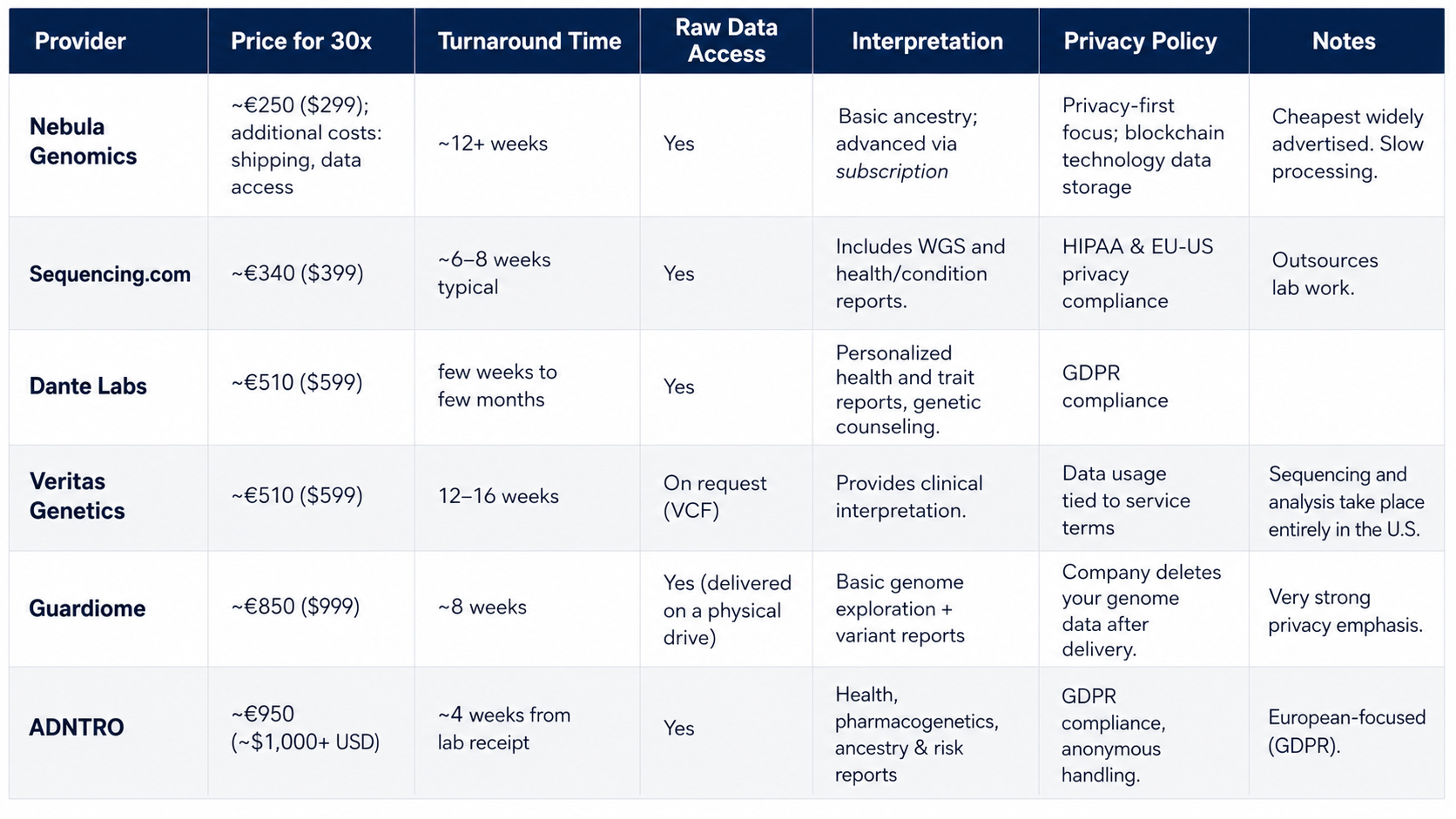
Pick the provider that suits your needs
Depending on your personal preferences, we can recommend different providers. If waiting time is not of your concern, but price and privacy are, then Nebula would be the ideal option. If however, you prioritize turnaround times, privacy and a European-market focused company, ADNTRO is your provider. If you want a personalized clinical interpretation and deeper health analysis, then we would advise you to go with Dante Labs or Veritas Genetics, as they both highlight their genetic counseling for clinically actionable findings. If safety of your data is of utmost concern, you might want to go with Guardiome, with their data deletion policy and physical data transfer.