


Signing a contract for your own cryopreservation is a strange moment.
The screen looks ordinary. You check a few details, read a PDF and add an electronic signature, probably from the same sofa where you sign an insurance policy or approve a phone contract.
But the document is meant to matter after you can no longer explain what you wanted.
That is the point of it.
The digital process should be simple. Complexity in the signing interface would not make your wishes more serious. It would only give you another reason to leave the tab open for six months.
Still, simple does not mean casual.
The contract turns “I want to be cryopreserved” into a documented arrangement. It records what Tomorrow.bio is authorized to do, what you selected, how the procedure is funded and which responsibilities remain with you.
You can read Tomorrow.bio’s current public contract package on our Data and Resources page before signing. I think you should.
Not because we expect every member to become a contract lawyer. We do not.
You should read it because this is one of the few documents in your life that may need to speak for you when you cannot.
A signature is not the main point
The current public package contains several connected agreements because they do different jobs.
The Biostasis Agreement covers the relationship between you and Tomorrow.bio. It records the cryopreservation option, membership arrangement, funding requirements and the conditions under which Tomorrow.bio can organize and perform the procedure.
It also says something that must remain clear: cryopreservation is experimental. The contract does not promise revival, and Tomorrow.bio cannot give you a probability that revival will become possible.
That uncertainty is also explained in our informed-consent information. The contract records a serious attempt under uncertainty. It does not remove the uncertainty.
The Body Donation Agreement with testamentary provisions deals with your body after legal death. In the published version, you direct that your body be transferred to Tomorrow Biostasis GmbH and assign Tomorrow.bio the care of the dead for the purpose of cryopreservation.
This is not a decorative attachment. A medical team cannot simply arrive and act because somebody remembers a conversation you had ten years earlier.
Then there is the Long-Term Storage Agreement. It authorizes the transfer of your cryopreserved body and the associated long-term storage funds to the Patient Care Foundation, subject to the agreement’s conditions.
The foundation becomes the legal custodian of both. It is a separate role from the standby, stabilization, cryoprotection and transport work organized by Tomorrow.bio.
The package can also include an optional decision about neural micro-samples for quality assurance. Optional really means optional. Read the choices and select the one you actually want.
These distinctions may sound legalistic at first. They become much simpler when you ask one question: who must be allowed and required to do what?
That is what the contract needs to answer.
Read the parts that keep the arrangement active
Most people focus on the signature box because it feels like the finish line.
It is not.
The current published agreement states that coverage starts after funding has been confirmed and the first membership fee has been received. It also states that the contract remains in force while the membership fee is paid, funding remains in place and the contract has not been terminated.
Later, the same agreement says the arrangement only becomes valid for cryopreservation when a valid and liquid funding method has been provided and all required documents have been signed and supplied.
So there is an important difference between signing a document and having a complete, operational arrangement.
Funding might come through life insurance or another method accepted by Tomorrow.bio. The exact route varies, but “my family will find the money” is not verified funding.
The funding setup article explains how to close that part properly.
The digital contract may not be the final form needed for every declaration either.
The published agreement specifically requires additional documentation confirming the body donation, testamentary instructions and care of the dead. Depending on the situation, those documents may need a handwritten signature, witnesses or notarization.
Tomorrow.bio provides drafts and tells members which additional documents are needed. You do not have to invent the legal structure yourself.
You do have to provide the requested information and return the documents.
This sounds obvious. It is also exactly where a serious intention can remain unfinished for months.
The contract asks you to keep Tomorrow.bio informed when your address, contact details, health situation or relevant contacts change. It also asks you to tell your next of kin about your wish and provide the people who should be contacted.
None of this is paperwork for the pleasure of paperwork.
If an emergency happens, our team needs your current location, a working contact chain, usable authority and funding that can actually be accessed. An old address and a surprised partner are operational problems, not administrative imperfections.
Our guide to important documents explains what should remain accessible after the signing process is over.
What the digital process should give you
The real advantage of digital signing is not that electronic signatures are futuristic. They are not.
The advantage is that the process can be completed from anywhere, questions can be resolved quickly and both sides can keep the same final record.
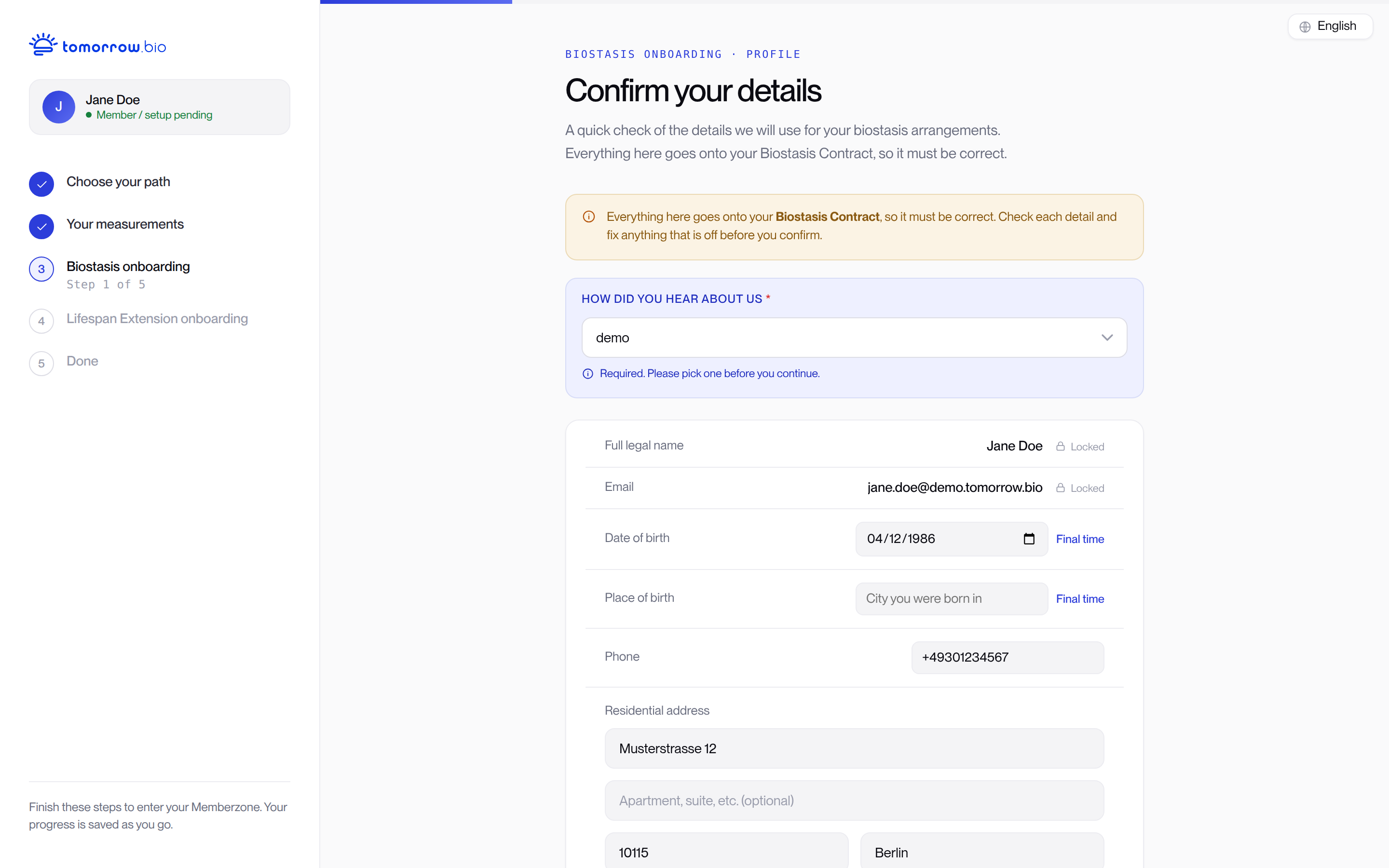
Before signing, check the boring details first: your legal name, date of birth, address, selected preservation option and membership plan. A typo does not become more intelligent because it sits inside a legal document.
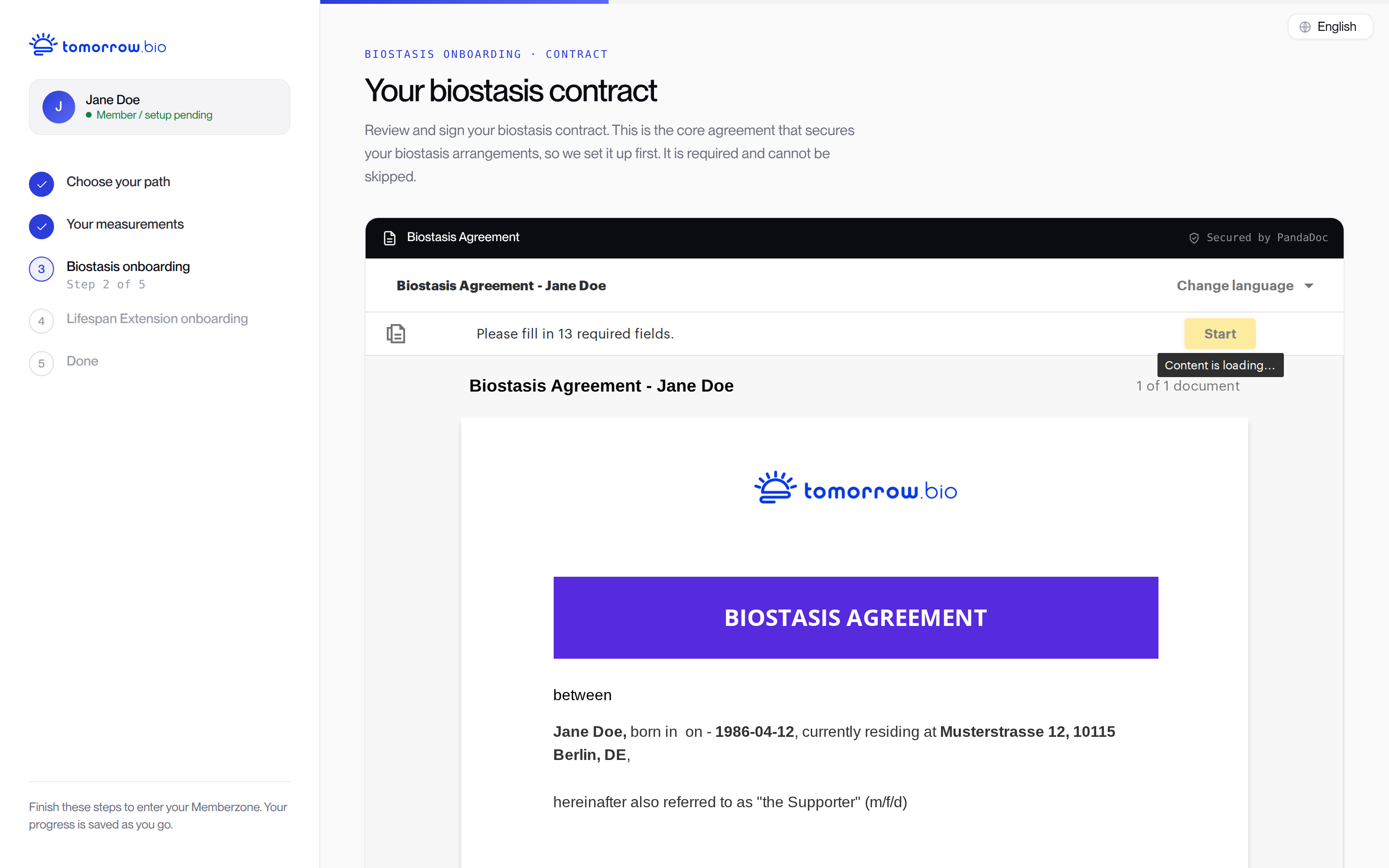
Then read the clauses about funding, your responsibilities, termination, body donation and the limits of what Tomorrow.bio promises.
If something is unclear, ask us. This is not a test where the clever member wins by staying silent.
We can explain the process, identify the relevant documents and help you understand what still needs to be completed. If your question requires advice about how the agreement interacts with the law where you live, you may also need a local lawyer.
Once you sign, Tomorrow.bio countersigns the agreement. Keep the final completed copy, not only the version you first opened.
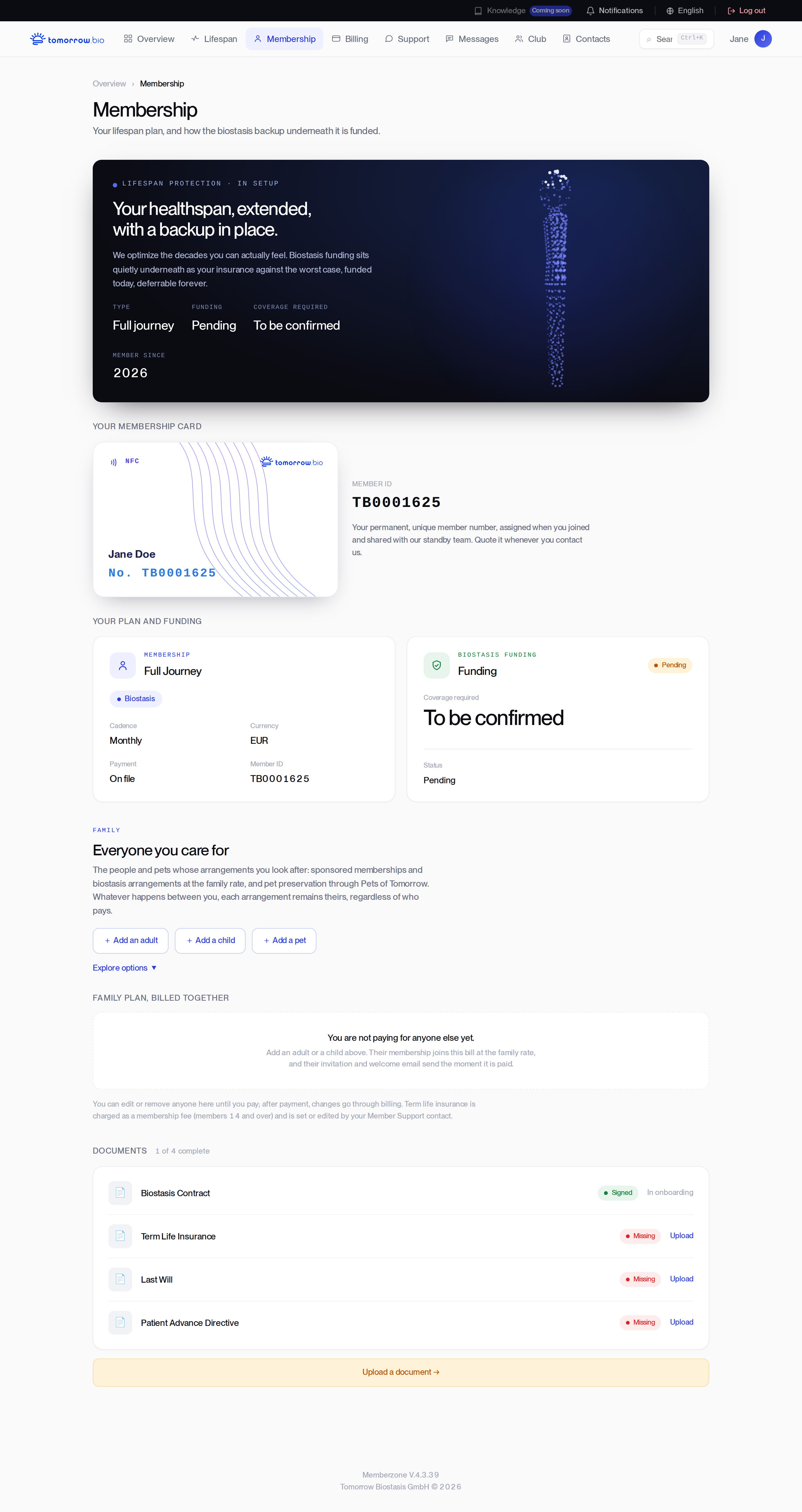
Confirm that the completed document and its status appear correctly in the Memberzone. If the status is unclear or the final copy is missing, contact us. Do not assume that silence means everything is done.
Save another copy somewhere your emergency contacts can reach. Online accounts can be forgotten, email addresses change and passwords disappear with people.
That external copy does not replace the Memberzone. It gives the people around you one more way to find the right information when time matters.
There is a human side to this too.
Signing often feels like the moment the decision is finished. In our member conversations, the emotional result was not uniform. Some people felt relief. Some felt calm. Others only felt settled once the funding and remaining documents were also complete.
That makes sense. The signature closes the decision. The rest of the system makes it usable.
Done means ready
A good cryopreservation arrangement should not depend on your family interpreting your preferences correctly while they are grieving.
Nor should it depend on someone discovering a PDF by accident.
The signed contract gives Tomorrow.bio the documented basis to act. Independent funding makes dispatch possible. The supporting declarations reinforce your wishes in the forms required for your situation.
Your emergency contacts make sure we hear about the emergency at all.
Once those pieces are in place, you are not expected to coordinate funeral partners, transport documents, cryoprotection or international transfer yourself. At the relevant time, Tomorrow.bio and the local partners handle that work.
Your job is much smaller: give us accurate information, complete the documents we request, keep the funding valid and make sure the people around you know whom to call.
Review the arrangement after moving country, changing your funding, receiving a serious diagnosis or changing the people closest to you. A contract signed years ago can still be valid while the practical information around it has become useless.
If you want the complete picture of what remains after signing, read ensuring your wishes are followed and from “maybe” to “done”.
The electronic signature is the easiest part of this process, and that is good.
Its purpose is not to make the arrangement feel impressive. Its purpose is to record a clear decision, give Tomorrow.bio the authority defined in the agreement and let the practical system around that decision be completed while you are alive and available to help.
TL;DR: The digital contract records your instructions and gives Tomorrow.bio the authority defined in the agreement. Your arrangement is only operational when the contract, accepted funding, required supporting documents and emergency contacts are all in place.
Further reading