



If vitrification is the goal, bringing a body into a stable glass-like state instead of destructive ice, then cryoprotectants are the trick that makes it physically possible. They are, almost literally, medical antifreeze. And like a lot of the most important tools in this field, they come with a sharp tradeoff. The whole procedure is designed around it. The thing that protects the tissue from ice is also toxic to it at the wrong dose. Understanding cryoprotectants means understanding how that tension is managed.
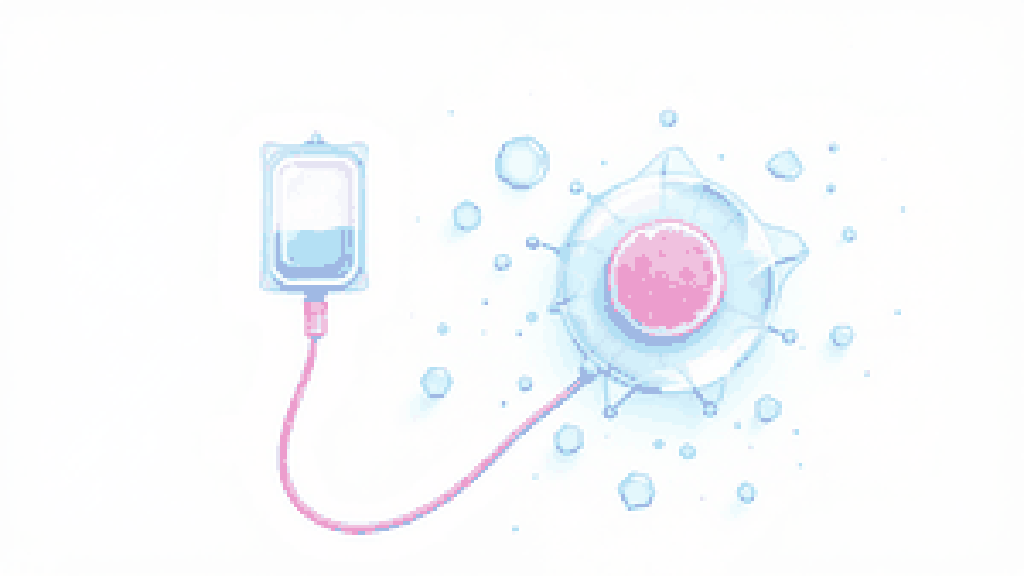
Why ice has to be stopped, by any means
Start with the enemy. When water freezes inside a body it causes two kinds of damage at once. The first is mechanical: as ice crystals grow, they crush the cells around them into narrowing channels of unfrozen liquid, deforming the fine structures inside. The second is chemical: as pure water freezes out, everything that was dissolved in it gets crammed into the shrinking liquid that remains, concentrating salts and solutes until that pocket of fluid becomes poisonous. Either one alone would be bad. Together they make ordinary freezing a reliable way to destroy the exact structures that encode who you are.
Cryoprotectants exist to make sure that ice never forms in the first place. Instead of freezing, the tissue passes into the glassy, vitrified state, and the structure is held as well as the perfusion allows.
What cryoprotectants actually are
A cryoprotective agent behaves a lot like the antifreeze you put in a car radiator: it dissolves in water and lowers the temperature at which that water would otherwise crystallize. The medical-grade versions used in cryonics, things like glycerol, ethylene glycol, propylene glycol, and dimethyl sulfoxide (DMSO), are chosen and blended for exactly that job. They come in two families that work as a team:
- Penetrating agents cross the cell membrane and prevent ice from forming inside the cell.
- Non-penetrating agents stay outside the cell and prevent ice from forming in the spaces between cells, where it tends to appear first. Penetrating agents cross the cell membrane and replace much of the water inside, preventing ice from forming within the cell itself.
They are used together for a reason that turns out to be central. Because the non-penetrating agents handle the easy, more ice-prone space outside the cells, the penetrating agents do not have to be pushed to such high concentrations inside them. And concentration, as we are about to see, is the whole problem.
The toxicity tradeoff, which is the real story
Here is the tension that defines the entire field of cryoprotection. To vitrify reliably, you need to replace a great deal of the body's water with cryoprotectant. But the higher the concentration, the more toxic the agent becomes to the tissue. Use too little and you get ice. Use too much and you get chemical damage. The art is threading the needle between them.
Two facts make the needle threadable. First, toxicity depends sharply on temperature: an agent that would harm tissue when warm is far gentler when cold. So the cryoprotectants are introduced gradually, at rising concentration, while the body is simultaneously cooled, keeping toxicity low at every step. Second, the right combinations of agents can lower the total toxicity of the mixture below what any single agent at full strength would cause. Getting that blend right is an active research problem, and improving it is one of the concrete levers on future revival quality.
The solutions themselves keep getting better
The cryoprotectant used today is not one chemical but a carefully tuned cocktail, and it is the product of decades of iteration. The cryobiologist Greg Fahy built his vitrification solutions in generations. Each one fixed a flaw in the last. Early single-agent mixes gave way to blends of DMSO with amides and propylene glycol. Ethylene glycol then replaced the more toxic components. Ice-blocking molecules came next, suppressing crystallization at lower concentrations. The final step adjusted the balance of the non-penetrating components to counter chilling injury. The current human-use agents sit at the end of that chain. Tomorrow.bio and the Cryonics Institute use an optimized version of a solution called VM1. It is built from roughly equal parts dimethyl sulfoxide and ethylene glycol. Other providers use proprietary formulations of their own. The two represent different trade-offs between cost and documentation. VM1 is far cheaper per case. Researchers even have a predictive measure of toxicity, written qv*, that helps design mixtures which vitrify reliably while doing the least harm. The point is that "the cryoprotectant" is not a fixed thing but a moving frontier, and every improvement directly raises the fidelity of a preservation, the theme of advancing the field.
The open problem nobody hides
There is one more honest wrinkle. At cryogenic temperatures, cryoprotectants are not toxic at all, because nothing is reacting; everything is paused. The toxicity is a problem of rewarming. On the way back up, the agents would need to be removed quickly and cleanly to avoid harming the tissue. Doing that well is a problem for the future medicine that would handle revival. It is not something solvable today. We say so plainly, because revival is currently not possible and pretending otherwise would be dishonest. The bet is that a civilization capable of repairing the original cause of death can also manage a controlled rewarming, and that the preserved structure gives it something worth working with.
That balancing act, more antifreeze versus less toxicity, is exactly where a lot of the ongoing research at Tomorrow.bio and elsewhere is focused. Every improvement in the mixture is a direct improvement in how faithfully a person's structure survives the trip to -196°C.
TL;DR: Cryoprotectants reduce ice formation and make vitrification possible. They can also cause toxicity and osmotic stress, so concentration, temperature and delivery must be carefully controlled.
Further reading