



Tell someone at a dinner party that you work on cryonics and the first thing you will hear, almost without fail, is some version of: "So, you freeze people?" It is the single most common belief about this field, and it is wrong in a way that matters. Cryonics does not freeze people. Freezing is, in fact, close to the worst thing you could do to a brain you are trying to keep. What actually happens is called vitrification, and the difference between the two is the difference between shattering a structure and setting it gently in glass.
To see why that distinction is the whole game, you have to look at what cold actually does to water, because a person is mostly water, the brain roughly 73% of it by weight, and water is the troublemaker.
What freezing actually does
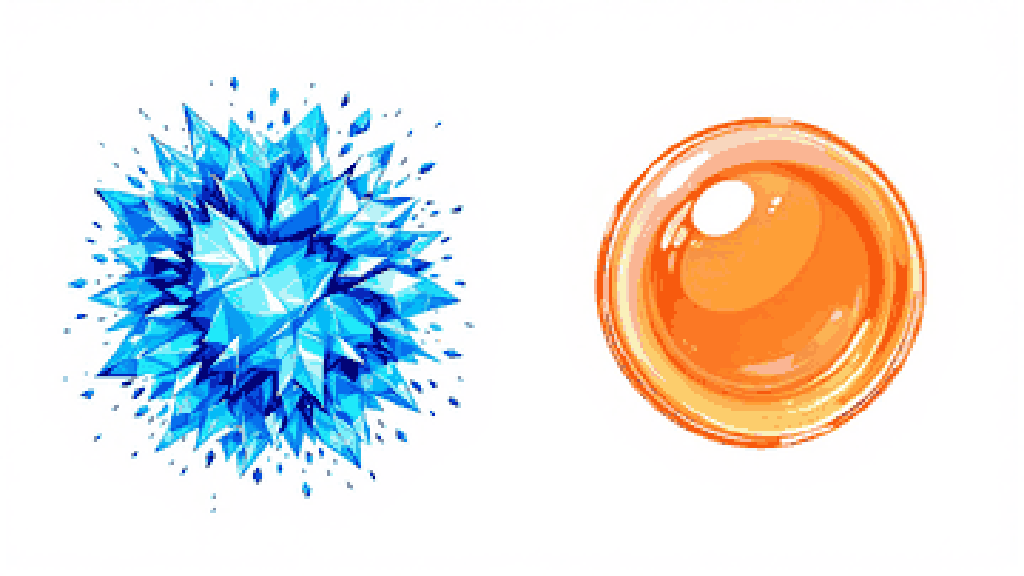
Water has a strange and, for our purposes, hostile property: it expands when it freezes. As liquid water cools to 0°C, its molecules slow down and lock into a rigid crystal lattice, and that lattice takes up about 9% more space than the liquid did. This is why a forgotten bottle bursts in the freezer. It is also why freezing is so destructive to living tissue.
When large tissue freezes, most of the ice forms in the spaces between the cells rather than inside them, and two bad things happen at once. The growing ice presses the cells into ever smaller spaces and distorts the tissue around them. At the same time, as pure water pulls out of solution to build ice, everything that was dissolved in that water, salts and other solutes, gets concentrated into the shrinking pockets of liquid that remain, until the chemistry there turns toxic. Mechanical crushing and chemical poisoning, delivered together.
You have seen the result on a small scale. Freeze a strawberry, thaw it, and it comes back mushy and limp, because the ice crystals ruptured its cell walls and the structure could no longer hold its shape. Now picture that same damage applied to the one organ where structure is the point. In the brain, where identity and memory live in the precise wiring described in memory, identity and the brain, that kind of crystal damage is exactly what we cannot allow.
Vitrification: solid without ice
Vitrification is the way out. The word comes from the Latin vitrum, glass, and that is precisely what it produces. A vitrified substance is solid and very cold, but it never crystallizes. Its molecules slow down and lock into place in the same disordered arrangement they had as a liquid, so there are no crystals, no expansion, no sharp edges, nothing tearing the tissue apart. The structure is held exactly as it was, frozen in time rather than frozen into ice.
Getting a human body to vitrify instead of freeze takes chemistry. Most of the water in the body is replaced with cryoprotective agents, a kind of medical-grade antifreeze, through a process called perfusion. These agents lower the temperature at which the remaining liquid would crystallize and let it pass instead into the glassy state. The body solidifies as it cools through the glass-like state-transition temperature, somewhere around -120°C to -130°C, and from that point on it is vitrified: biologically paused, structurally preserved, all the chemistry of decay slowed to a crawl.
What vitrification looks like in practice
This is not a single dunk into something cold. It is a careful, staged medical procedure that starts the moment it has to. After legal death is pronounced, every minute costs structural fidelity, so the first job is speed, the race against cellular decay that this whole field is organized around. A standby team works to stabilize the patient, restore circulation, and begin rapid cooling, while keeping the body above the freezing point so that no ice forms before the protective agents are in.
Then comes the perfusion: the cryoprotectant is introduced into the circulation at slowly rising concentration, gradually replacing the body's water while the temperature is brought down. Only once the tissue is saturated is the patient cooled the rest of the way, eventually reaching -196°C for long-term storage in a dewar. Every step exists to keep one promise: glass, not ice.
So the next time someone asks whether you are "freezing dead people," you have a precise answer. No. We are doing the opposite of freezing, on purpose, because freezing would wreck the very thing we are trying to save.
TL;DR: Freezing forms ice crystals that damage tissue. Vitrification uses cryoprotectants and controlled cooling to reach a glass-like state with much less ice formation.
Further reading