



If you spend ten minutes around cryonics you will hit the acronym SST, and it is worth getting right, because it names the part of the process that does the most to decide whether any of this works. SST stands for Standby, Stabilization and Transport, in that order, and the team that runs it is the difference between a high-quality preservation and a wasted one. The whole job is a race, and the starting gun is legal death.
Here is the uncomfortable physics that makes SST necessary. The moment the heart stops, the brain is cut off from oxygen and its cells begin to die. Since your memories and personality are held in the structure of that brain, every minute of delay is a small, permanent subtraction from the person you are trying to save. SST exists to make that delay as short as humanly possible.
S is for Standby
Standby is the team getting into position before they are needed. Most members die in hospital from a known, worsening condition, so when death looks imminent the family or the doctors alert the team and it deploys, by standby ambulance, rapid-response vehicle, commercial flight, or in extreme cases a chartered medical jet, carrying portable equipment to the bedside. Then they wait. Standby can last hours or days. Nothing begins until a physician declares legal death, because by law nothing can.

Sudden, unexpected death is the hard case: the team gets no warning and most of the window is lost before anyone can act. This is a genuine limitation of cryonics, and part of why some deaths cannot be preserved well, or at all.
The second S is for Stabilization
The instant legal death is declared, stabilization begins and the clock that matters most starts running. The patient is moved into an ice bath and cooled fast. A mechanical chest-compression device keeps blood, and therefore oxygen, moving to the brain while protective medications are given. Only then does cryoprotectant perfusion begin, replacing the body's water with agents that stop ice from forming as the temperature falls. With the cryoprotectant loaded, the patient is cooled on dry ice to around -79°C for transport, cold enough that biological decay has effectively stopped. Vitrification into a glass-like state rather than ice comes later, during the slower cooling at the facility. The dangerous part of the race is over.
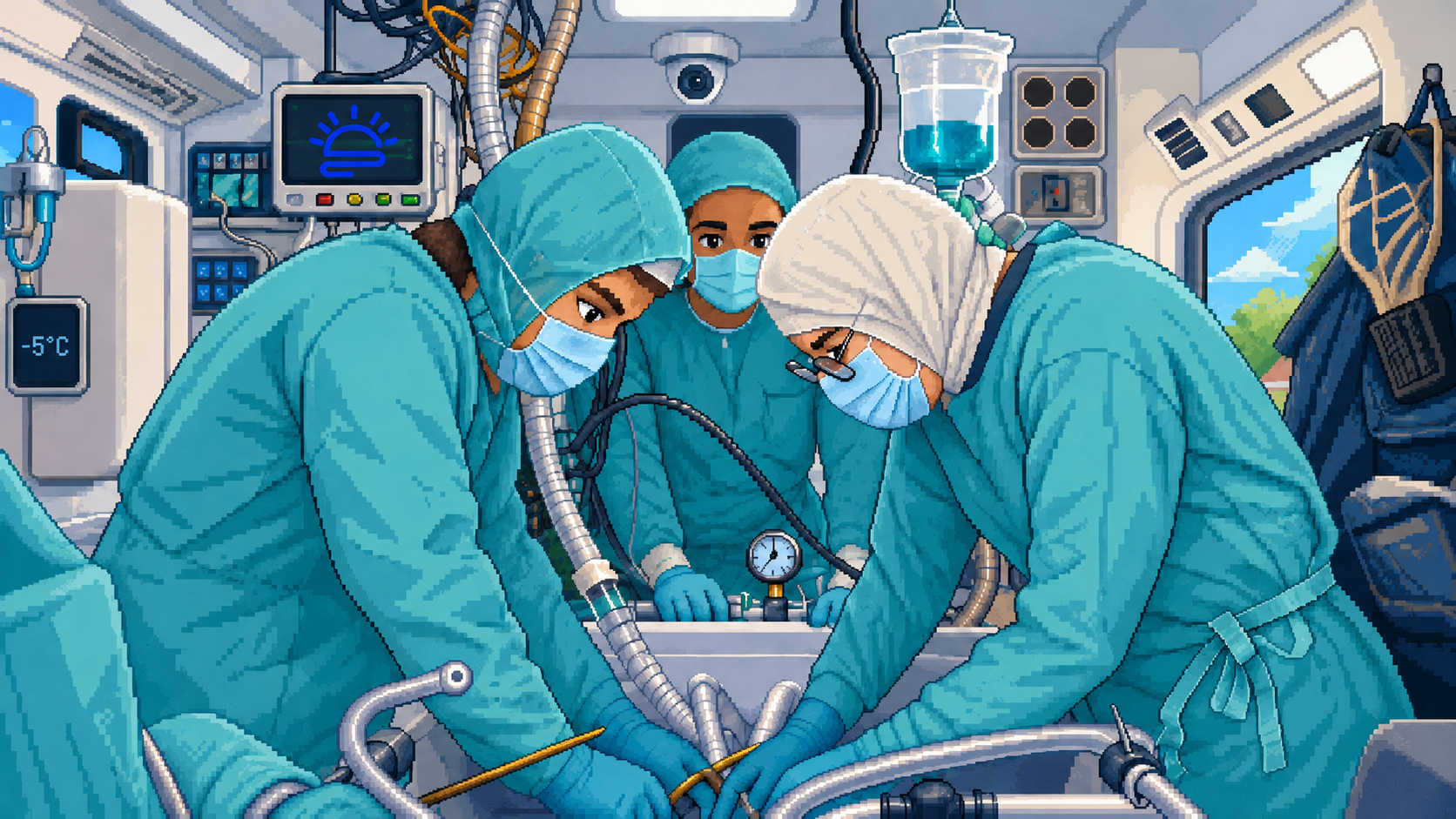
T is for Transport
What is left is logistics, which sounds trivial and is not. Tomorrow.bio's long-term facility is near Rafz, Switzerland, while members can die anywhere in Europe, so the patient has to cross borders legally. The standby ambulance is registered as a funeral vehicle for exactly this reason, and funeral-home partners cover the gaps the ambulance cannot reach. At the facility the patient is cooled the rest of the way to -196°C over about a week. Somewhere around -130°C the cryoprotectant solution crosses its glass transition and the tissue sets into a glass-like state rather than ice. The patient is then placed in a storage dewar, where they can wait without further change.

Why not skip it and just ship the body?
It is a fair question, and the answer is the whole point. Delivering a body to storage days after death, with no standby and no stabilization, would be far cheaper; you would not need trained teams on call around the clock with specialized equipment. But it would also defeat the purpose, because preservation quality, with today's technology, is set almost entirely by how fast the procedure starts. Skipping SST saves money by sacrificing the exact thing you are paying to protect.
So the trade is deliberate: maintain expensive, redundant, always-available teams rather than lose part of a person's future self for convenience. SST is where cryonics stops being a philosophical bet and becomes an emergency-medicine operation with a stopwatch.
TL;DR: SST means Standby, Stabilization and Transport. It limits damage after legal death by starting cooling and circulatory support quickly, then coordinating cryoprotection and transport.
Further reading