



Ask a doctor to define death and you will get an answer that has changed at least three times in the last century. A heart that stopped was once the end of the story; then we learned to restart it. Breathing that ceased was once final; then came the ventilator. Each time medicine gained a tool, the line marking dead quietly moved, and people who would have been buried under the old definition walked out of the hospital under the new one. Biostasis starts from that observation and asks the obvious follow-up: if the line keeps moving, what is it actually tracking?
The honest answer is that death has never marked a single physical event. It marks the point where today's medicine gives up. To think clearly about cryonics you have to pull apart the several different things that one word is doing.
Death is not one event but several
Medicine already separates the stages, and they do not happen at the same instant.
- Clinical death is when the heart and breathing stop. For a few minutes the tissues are still intact and the person can often be brought back, which is exactly what CPR and defibrillation do; at normal body temperature, brain cells start to die within about five minutes of losing oxygen.
- Legal death is a declaration by a physician that vital functions have ceased by current standards. It is a bureaucratic line, not a biological one, and it is the moment the law allows cryonics to begin.
- Biological death is the slow one: cells run out of oxygen and energy, structures break down, and decay sets in.
The definition that actually matters
Cryonics works from a stricter and, on reflection, more honest definition. A person is not truly gone when their heart stops, or when a physician signs a form. They are gone when the information that encodes who they are, the specific physical structure in the brain that holds memory and personality, has been destroyed past any possible recovery. This is called information-theoretic death, and it is a far higher bar than legal death. As long as that structure is physically intact, the person is in principle still recoverable by a future medicine good enough to read and repair it. The case for why structure is the right thing to track is made in memory, identity and the brain.
The cryonics window
Put those definitions on a timeline and a gap opens up. Legal death comes first; information-theoretic death comes later, sometimes much later once the body is cooled. Everything cryonics does happens inside that gap, the cryonics window shown in the diagram below. The instant legal death is declared, the standby team begins cooling and cardiopulmonary support. It then replaces the blood with cryoprotective agents, stabilizing the brain's structure before decay can close the window. These agents exist to prevent ice from forming, so the tissue does not freeze. It cools into a stable, glass-like state called vitrification.
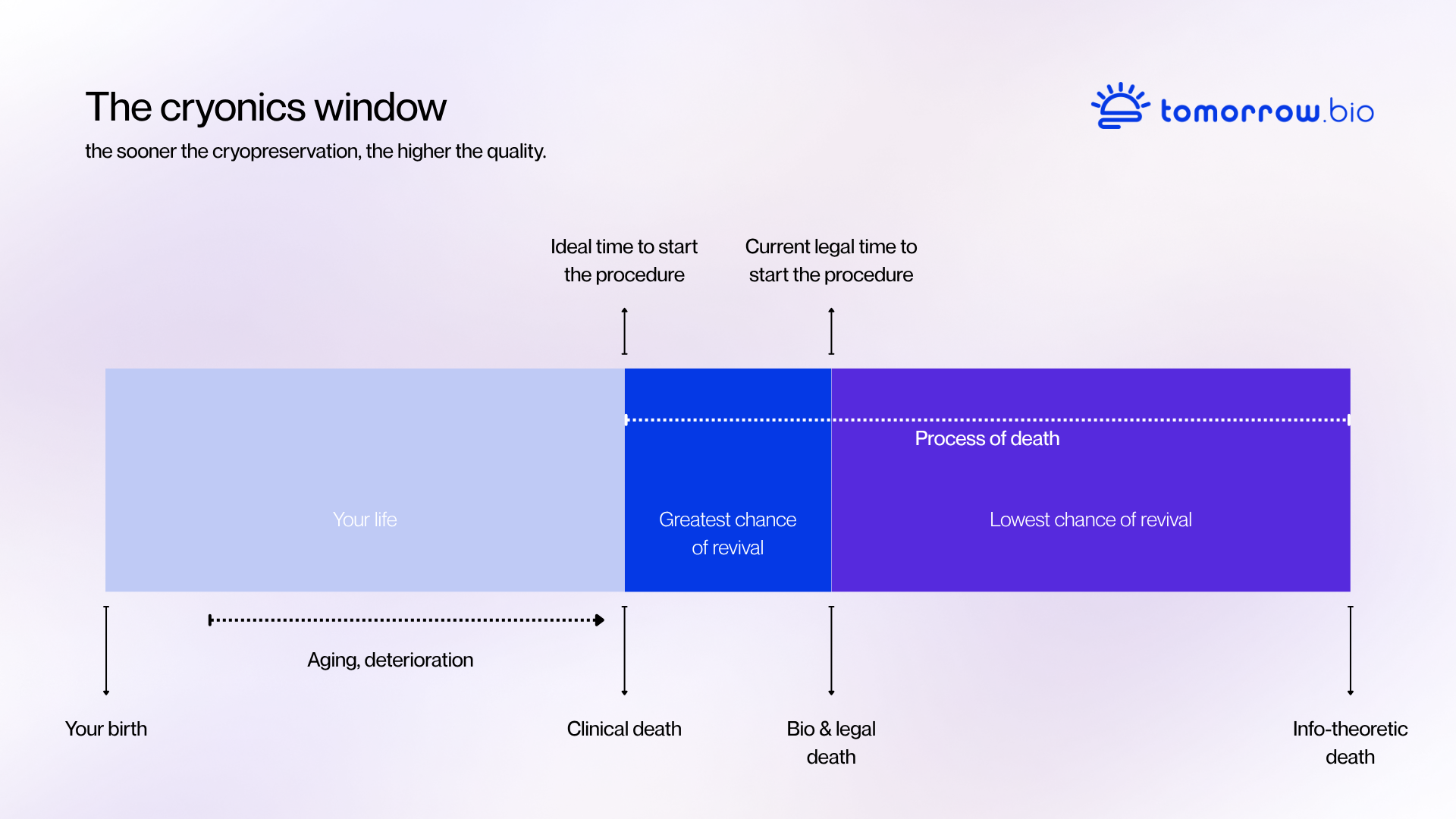
This is why speed is the whole game. The clock starts at legal death, and every minute of delay lets cellular decay eat into preservation quality. Ideally the procedure would start the moment the heart stops, when everything is still intact, but the law requires a declaration of legal death first, so the realistic goal is to lose as little of the window as possible.
Why the reframing changes the decision
Once you see death as the loss of information rather than the loss of a heartbeat, the choice in front of you changes shape. Burial and cremation guarantee information-theoretic death; they finish the job. Cryopreservation is the only option that tries to keep the information intact while the question of future repair stays open. You do not have to be certain revival will work to notice that a chance above zero beats a chance of exactly zero.
TL;DR: Legal death means current medicine has stopped treatment. Biostasis acts before decay destroys the brain structure that may contain memory and identity.
Further reading