



The history of cryonics is not really a history of freezers. It is the history of one stubborn question, asked again every time medicine got better at its job: when a doctor writes down the time of death, what has actually been established? That a person is gone, or only that today's tools have run out? Biostasis is the modern answer to that question, but the question is far older than the technology, and the story of how we got here is mostly a story of people taking it seriously before it was respectable to do so.
What follows is the honest version, including the parts the field is not proud of. The early decades produced one genuinely good idea, a few institutions that endured, and several avoidable disasters, and you cannot understand why modern cryonics is built the way it is without all three.
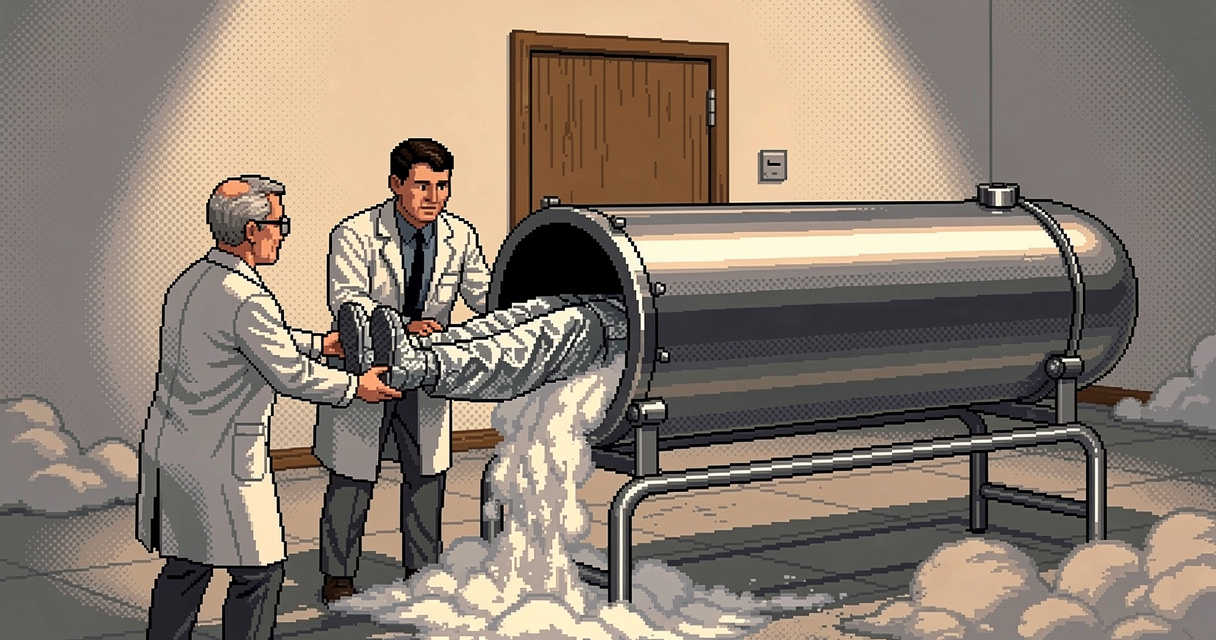
An old curiosity, waiting for a reason
People have wondered about cold and preservation for as long as they have watched winter pause a landscape and spring restart it. For most of that time it stayed idle speculation, because there was no mechanism and no point. The mechanism arrived first. Through the 1940s and 1950s, cryobiology produced something concrete and surprising. Cells, sperm, and small tissues could be cooled to very low temperatures and rewarmed alive. The condition was treatment with cryoprotective agents that kept ice from shredding them. As early as 1953 a child was born from sperm that had been cooled with dry ice and stored, a decade before anyone proposed doing the same for a whole person. Freezing did not have to mean destruction. That single line of laboratory results is the seed of everything that follows, because it turned preserve a human from a fantasy into an engineering question with a known starting point.
What was still missing was a reason to point that capability at people. Preserving sperm is useful. Preserving a person only makes sense if you believe death is a process you can interrupt rather than an instant you cannot. Someone had to say that out loud.
1962: Ettinger says the quiet part out loud
That someone was Robert Ettinger. He was born in 1918. The idea had captivated him since the age of twelve. A 1931 pulp story called The Jameson Satellite imagined a man's body preserved in the cold of space, then revived in the distant future. He carried the notion through a wound suffered in the Battle of the Bulge and a career teaching physics. In 1962 he finally set it down, circulating a manuscript titled The Prospect of Immortality. Doubleday published it in 1964, the Book of the Month Club selected it, and it eventually appeared in nine languages. His argument was almost aggressively simple. If death is a process, and if we can already halt biological decay with cold, then a person preserved soon after the heart stops is not necessarily gone. They are waiting, in a state current medicine cannot reverse, for a medicine that perhaps can. The word cryonics, from the Greek kryos for cold, was coined a few years later to name the procedure.
Most of us now living have a chance for personal, physical immortality.
Robert Ettinger, The Prospect of Immortality, 1964
Ettinger was not entirely alone. Around the same time the writer Evan Cooper independently argued the same case and founded the Life Extension Society in 1963 to promote it, even offering to arrange the first human preservation. The move both men made is the one the whole field still rests on, and it is worth stating precisely: they reframed preservation as an extension of emergency medicine rather than a denial of death. A defibrillator buys minutes. Cooling, they argued, might buy centuries. The bet is not that the future is magic; it is that dead is a statement about present capability, and capability keeps moving.
1967: the first man, who is still waiting
Theory became practice on 12 January 1967, when James Bedford, a retired psychology professor dying of cancer at 73, became the first person ever cryopreserved, by a small team from the Cryonics Society of California. By the standards of today the procedure was crude, performed before vitrification existed, and Bedford left a sum of money to support research into the very idea he was betting on. What makes him remarkable is not the technique but the fact that he is still preserved today, more than half a century later. His care passed to Alcor, which re-examined him in 1991 and found his body had remained in good condition, and he has outlasted the very organization that first stored him. He is the existence proof that the chain of custody this idea depends on can, in fact, hold across decades and across the collapse of the people who started it.
By the late 1960s small groups of scientists and enthusiasts were forming organizations to do this deliberately. They established the skeleton that modern cryonics still uses: intervene immediately after legal death, cool fast, perfuse with cryoprotectant, and store long-term in liquid nitrogen.
The 1970s nearly killed it, and that was the lesson
Here is the part the field does not advertise, and should. Good intentions are not a preservation strategy. Several early patients were lost. The most infamous case was a facility in Chatsworth, California. An underfunded operator named Robert Nelson kept a small group of patients in an underground vault. Money and equipment failed through the 1970s, and he let almost all of them thaw. The families were largely kept in the dark. It ended in a lawsuit and a deserved scandal.
The right reaction to that history is not to look away from it but to notice what it forced. The failure was never the physics; it was money, governance, and honesty over long timescales. Modern cryonics is, in large part, the institutional response to Chatsworth. Preservation is prepaid and funded in advance rather than billed to grieving relatives. Patient care is structured to survive the organization that started it. The whole enterprise leans toward transparency, precisely because its worst moments came from the opposite. We still argue against ourselves in print for the same reason.
The institutions that endured
The answer to Chatsworth was not to abandon the idea but to build organizations designed to last. In 1972, Fred and Linda Chamberlain founded what became the Alcor Life Extension Foundation. The name comes from a faint star long used as a test of eyesight. It eventually settled in Arizona and remains one of the largest providers. Its patients range from ordinary members to the baseball player Ted Williams. In 1976, Ettinger himself founded the Cryonics Institute in Michigan. He then put his convictions to the most personal test imaginable. His own mother, Rhea, became its first patient in 1977. Ettinger was cryopreserved there himself in 2011, at the age of 92. These organizations mattered because they treated longevity of the institution, not just the patient, as the core problem, the theme picked up in building organizations meant to last.
Vitrification: from freezing to glass
The other half of the modern era is technical. Ordinary freezing, even with cryoprotectants, still forms some ice, and ice tears the fine structure that matters most. The breakthrough came in 1984, when the cryobiologist Greg Fahy proposed vitrification as an approach to preservation: load the tissue with enough cryoprotectant and cool it fast enough that the water never crystallizes at all. Instead it sets into a glass-like state, a solid with no ice and no sharp edges. The mechanism is viscosity: as the cryoprotectant-loaded tissue cools, the solution thickens by orders of magnitude until the water molecules are too immobile to arrange themselves into a crystal lattice. Cryonics adopted it around the turn of the century, and in 2000 a person known as FM-2030 became the first patient to be vitrified rather than frozen. The same line of research later vitrified, rewarmed, and transplanted a whole rabbit kidney. The organ went on to function as the animal's only kidney. That result was published in 2009. The kidney had been cooled to around -130°C in a concentrated cryoprotectant solution. This is about as direct a proof of principle as the field has. The cryoprotectant solutions themselves have been refined through generation after generation toward ever lower toxicity.
Vitrification is why a procedure that began as crude freezing in 1967 is now a standardized medical operation. Today a standby and stabilization team begins work within minutes of legal death. Perfusion is done with medical-grade equipment and optimized solutions. The patient is then cooled toward storage at -196°C, the temperature of liquid nitrogen. That holds the tissue far below the glass transition of the cryoprotectant solution near -125°C. Below that point molecular motion, and with it biological time, effectively stops.
The field comes to Europe
For most of its history cryonics was an almost entirely American affair. Europe changed that in 2020, when Tomorrow.bio began operating alongside its sister non-profit, the European Biostasis Foundation. The company was incorporated in 2019, but that year was paperwork. They built a dedicated storage facility in Switzerland. For the first time, trained standby teams and rapid stabilization reached patients across Europe. Asia and Australia built their own programs on separate timelines. The Shandong Yinfeng Life Science Research Institute was founded in Jinan in 2015, and cryopreserved China's first patient in 2017. Southern Cryonics was registered in Australia in 2012, and opened its Holbrook facility in 2024. The significance is less about geography than about maturity: cryonics had grown from a single physics teacher's manuscript into a field with medical protocols, ambulances, research programs, and institutions on four continents. The fuller version of that chapter is told in a brief history of Tomorrow.bio.
Where the history is still being written
Cryonics is not a finished story, and pretending otherwise would betray the honesty the early failures taught. Revival is still not possible; we say so plainly. What has changed over sixty years is the strength of the foundation under the bet. The preservation step is real and improving. The institutional design now carries scar tissue from its own mistakes. And the work on how revival might eventually work treats it as an engineering problem rather than a hope.
That idea is older than the freezers, survived its own worst operators, and is in better technical shape now than at any point in the story so far. The rest of this Codex is what it looks like when you take it seriously.
TL;DR: Cryonics developed from early freezing attempts into procedures based on vitrification, rapid response and liquid-nitrogen storage. Revival remains impossible, but preservation methods and institutions have improved.
Further reading